Tuesday, October 21, 2014

10 Points on Photosynthesis


  • Photosynthesis converts light energy (carried by photons) into ATP, which is a molecule which can store energy in a form that is usable by the plant.
  • Chloroplasts are transparent organelles which contain grana, which are stacks of thylakoids which in turn contain a green pigment called chlorophyll. This is where photosynthesis takes place.
  • Chlorophyll absorbs all wavelengths of light except for green (and yellow), which they reflect to our eyes.
  • An electron transfer chain is used to synthesize ATP
  • Oxidation occurs when electrons are lost. Reduction occurs when electrons are gained.
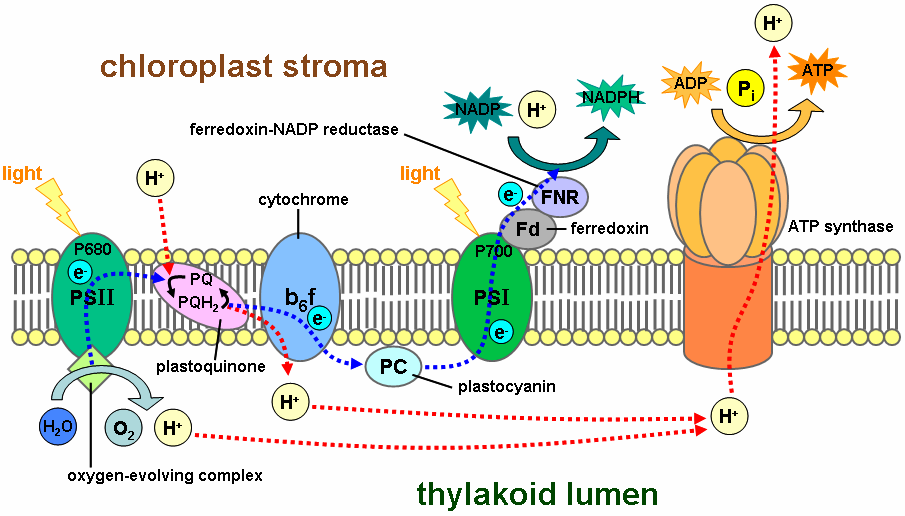
  • PS2 (Photosystem 2) is simulated by light of wavelength 680 nm and takes two electrons from a water molecule, breaking the covalent bond which holds it together. Oxygen and H2 are separated.
  • The electrons travel through the transport chain using oxidation and reduction reactions. It goes from PS2 to PQ to B6F. B6F pumps hydrogen ions into the chloroplast when it gets the electron, and then passes it on to PC.
  • The next link in the chain is PS1 (Photosystem 1). It gets simulated by light of wavelength 700 nm and is then reduced. The electron then goes to Fd (ferrodoxin) and FNR.
  • NADP is the end of the chain, and a positive hydrogen ion (proton) neutralizes it.
  • ATP is formed by ATP synthase. It spins ADP around. (when this combines to one phosphate it becomes ATP). The hydrogen ions 'slow' the spinning down and the last phosphate attaches to the combination and becomes ATP.

Saturday, October 18, 2014

Fetal Pig Dissection

Day 1 — Abdominal Cavity & reproductive system

This week, we had the opportunity to perform a fetal pig dissection. I, along with my group members (Benn, Amriya, Amir and Jianan), performed the dissection on a pig fetus to see the various organs and organ systems as they appeared in real life. We began the lab by gathering all the required materials; including scissors, pins, a scalpel, latex gloves, and goggles.

Our pig was female because of the urogenital papilla near the anus. We started by going through the lower body; the first day of the two-day lab would be devoted to exploring the abdominal cavity. Following our handout, we first made an incision along the stomach, followed by an incision laterally across it and around the umbilical cord to expose the abdominal cavity.


The umbilical vein was visible at this point, and we had to cut it to get to the organs underneath.


The umbilical vein is the elastic-looking cord ending at the liver.
The first organ we encountered was the liver. The umbilical vein led to the liver. It was a large structure which surrounded the stomach and parts of the small intestine.

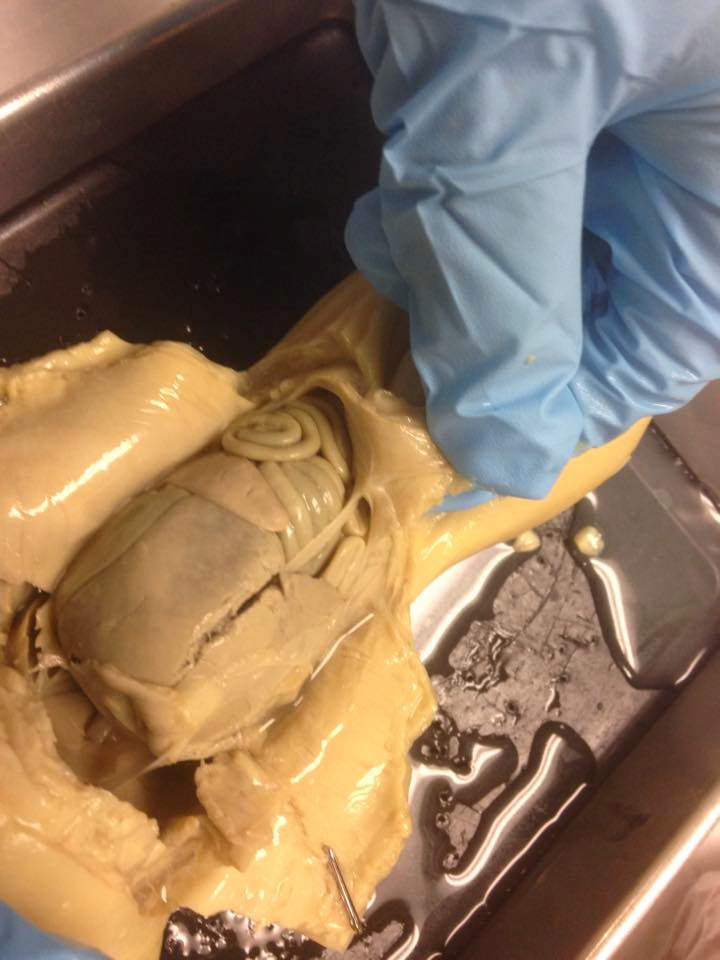
After removing the liver, most of the other parts of the cavity were visible. The stomach is visible in the following pictures, as well as the large & small intestine and one of the kidneys. The structure running along the stomach is the spleen, where blood cells mature. The pancreas is right under the stomach.

Inside the abdominal cavity
The liver
Stomach, small & large intestines, spleen
 and pancreas
Kidney (Located at the back and to the sides
- we left the other one inside).

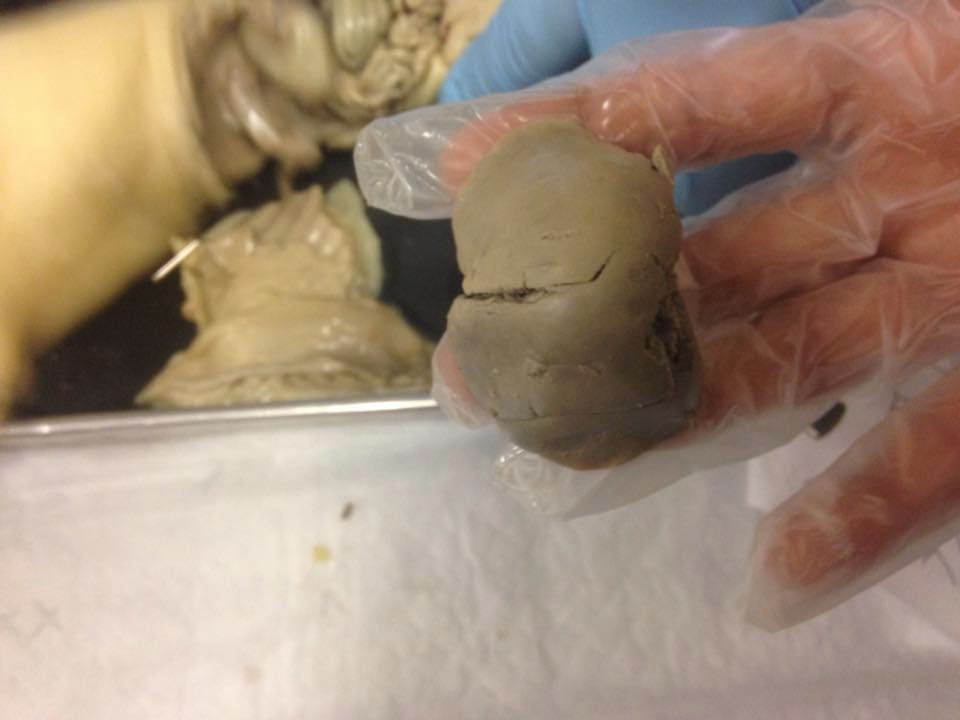
The stomach wasn’t empty. Inside were small dark objects inside a fluid. [below, left]

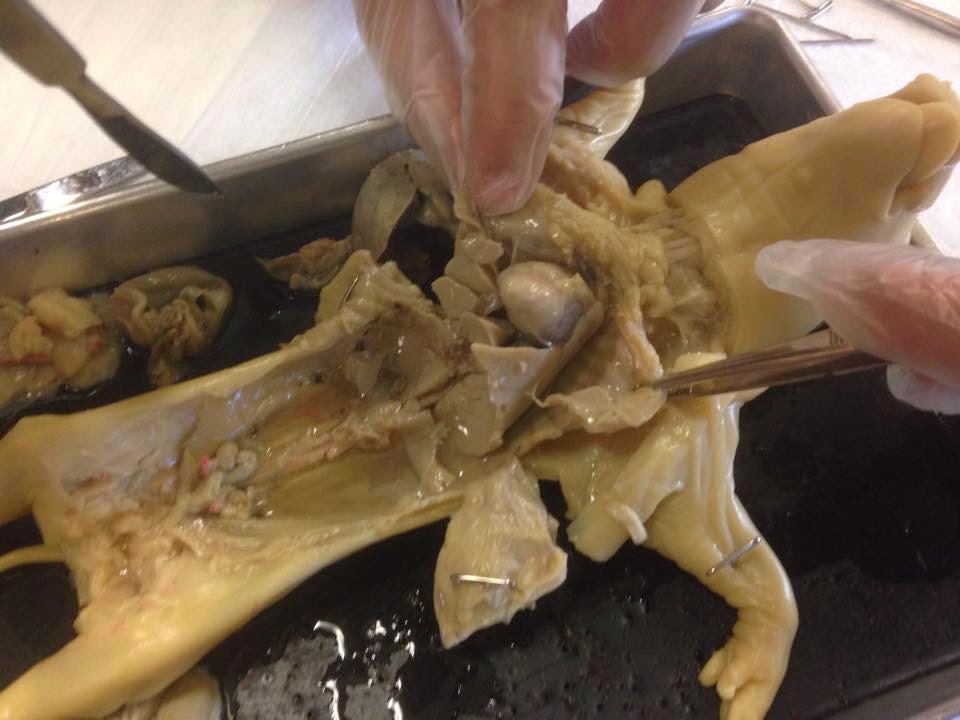
The uterus was then removed. The urinary bladder is the sac in between the two reddish tubes. The ovaries are located behind it. [above, right]

Day 2 — Thoracic cavity and head

On the second day of the dissection, we moved up to the thoracic cavity. Inside we were able to locate the heart, lungs, and thyroid glands. The heart was the first organ we encountered, surrounded by the aorta and various other veins and arteries. This is the center of the circulatory system, so there were larger blood vessels (to hold a larger amount of blood from the rest of the body) and the heart was very muscular, to be able to pump blood non-stop all around the body.


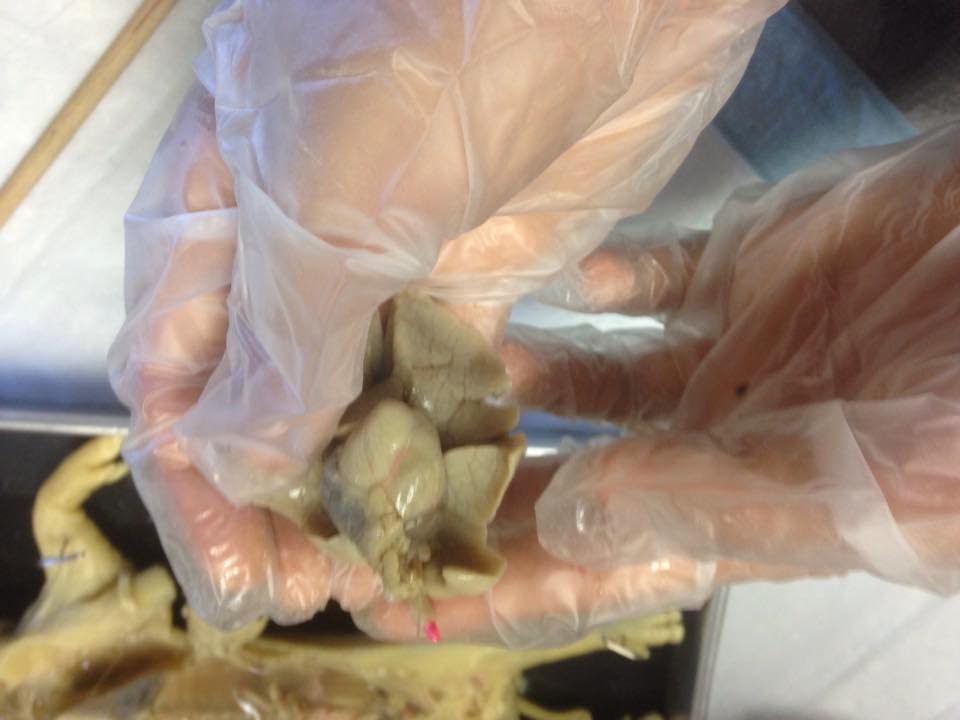
Heart, surrounded by ribcage and lungs
Heart with lungs
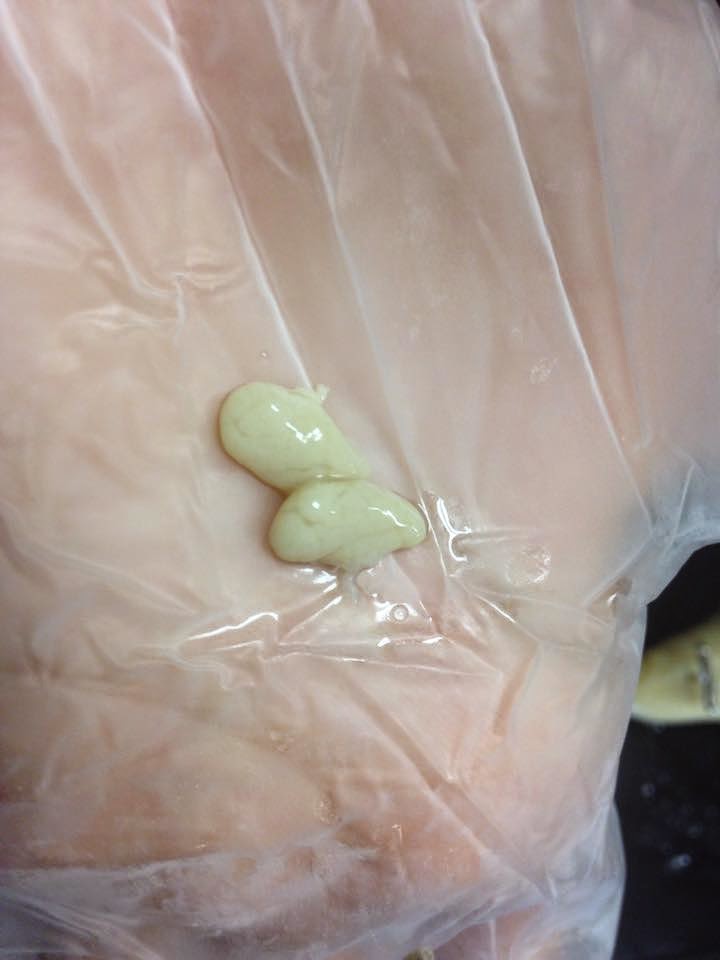
Moving further up the chest and into the neck area, we were able to isolate the thyroid gland. We found it near the esophagus and the various muscles and blood vessels which were going to the head. The thyroid gland is responsible for controlling the growth of the pig, and would have released the growth hormones necessary for the development of the pig. The parathyroid glands are supposed to be located on the thyroid gland, but we were unable to isolate them.


Thyroid gland
Our next step was to proceed to the head; isolating the brain (and hopefully, the brainstem). We had to exercise extra caution during this part because we had to cut through cartilage (the bone hadn’t developer yet) in the skull, all while trying not to damage the brain. Below are a few pictures of this process. In the end, while we could see the brainstem, we weren’t able to extract it along with the brain. 


The last part of our process was isolating the eye. Located close to the brain, this is one of the most developed organs we had examined so far. Inside, we could see a small yellowish sphere — which was the lens.


Wednesday, September 17, 2014

The Story of Stuff

In class, we watched a short video titled "The Story of Stuff," about everything that's wrong with our consumerism. Here are my answers to the odd numbered questions on the analysis sheet:

1) The overall message of this film is that our current trend of consumerism, wastage, and disregard for third world countries and the environment is unsustainable and unethical. It shows that we are rapidly running out of resources and that corporations now have more control than the government, controlling most of the economy.

3) Annie uses a lot of persuasive methods to convince the viewer of her argument. for one, whenever she wanted to make a point she asked questions and then answered them (and the answer always helped her argument, obviously). Also, she sometimes exaggerated facts and compared them to situations which are more common in everyday life, allowing the viewer to relate to them easily.

5) Annie also has some bias in her video, including some exaggerations and her own opinions on some things. Additionally, only the facts form her side of the issue are presented.

7) I believe it makes a convincing argument. The ideas presented in the video made sense and reflected society as we know it which made for a believable message.

Monday, September 8, 2014

Documentary: "The Cove"

In class, we watched a documentary about the slaughter of dolphins in a hidden "secret" cove in Taiji, Japan.
Here are my answers to the odd numbered questions on the question sheet:

1) The documentary is about Ric O'Barry, a former dolphin trainer and currently an activist against dolphin killing and whaling.
3) Ric O'Barry realized that dolphins and other cetaceans were miserable in captivity and often got stressed and died (even committing suicide, in some cases). He was devoted to this cause after his beloved dolphin, "Flipper," died.

5) Dolphins fall under the mammalian order cetacean.

7) The whalers get paid a lot for live dolphins and whales.

9) Some of the dolphins (mostly the females) are taken into captivity by aquariums and marine parks. The rest are killed for their meat (which is toxic to humans but is still sold as whale meat to the unknowing population).

11) The point is to reveal what is happening in Japan, as this isn't common knowledge even among their own people. Also, it sheds light on the lives of dolphins and whales that are held in captivity in aquariums and marine parks.

13) Biomagnification is the process of a certain chemical (or pollutant) becoming more concentrated in species higher up in the food chain. For example, dolphins, which are at the top of their respective food chain, have a high concentration of mercury. This occurs because the smaller concentrations in other organisms get absorbed by the dolphins and it adds up.

15) The reason many fishermen turned down offers of money to discontinue their practice of whaling was because of a sense of nationalism; they didn't want the west to have any ore influence on Japan's actions. This is due to the large effect the west had on Japan after World War 2.

17) The cameras are disguised as rocks and placed in vantage points.

19) The crew member shows the Deputy of Fisheries footage (obtained form the hidden cameras), which shows numerous dolphins being slaughtered in an inhumane manner.

21) They see an injured baby dolphin trying to flee from its assailants, leaving behind a trail of blood, only to die partway through and sink. :(

23) Dolphins and cetaceans are highly intelligent and social creatures which undergo a lot of stress under captivity. Marineland and other  marine parks / aquariums obtain their supply of animals from places like Japan. As long as these parks continue to purchase dolphins, whaling and dolphin capturing will continue. In a way, people who go to marine parks such as Marineland are indirectly (and often unknowingly) contributing to whaling practices elsewhere in the world.

Sunday, September 7, 2014

Mark & Recapture Sampling

Scientists and researchers who need to keep track of a population employ procedures such as Mark and Recapture Sampling to provide them with a reasonable estimate of the population size.

This method consists of a number of individuals being captured and marked, then released back into their habitat. After an appropriate length of time, usually a few days or  weeks, traps are laid out and another 'sample' of the population is captured. Of these, the number of recaptured individuals who had been captured in the first batch (the ones that were already marked) are counted, and the following formula is used to estimate the size of the entire population:


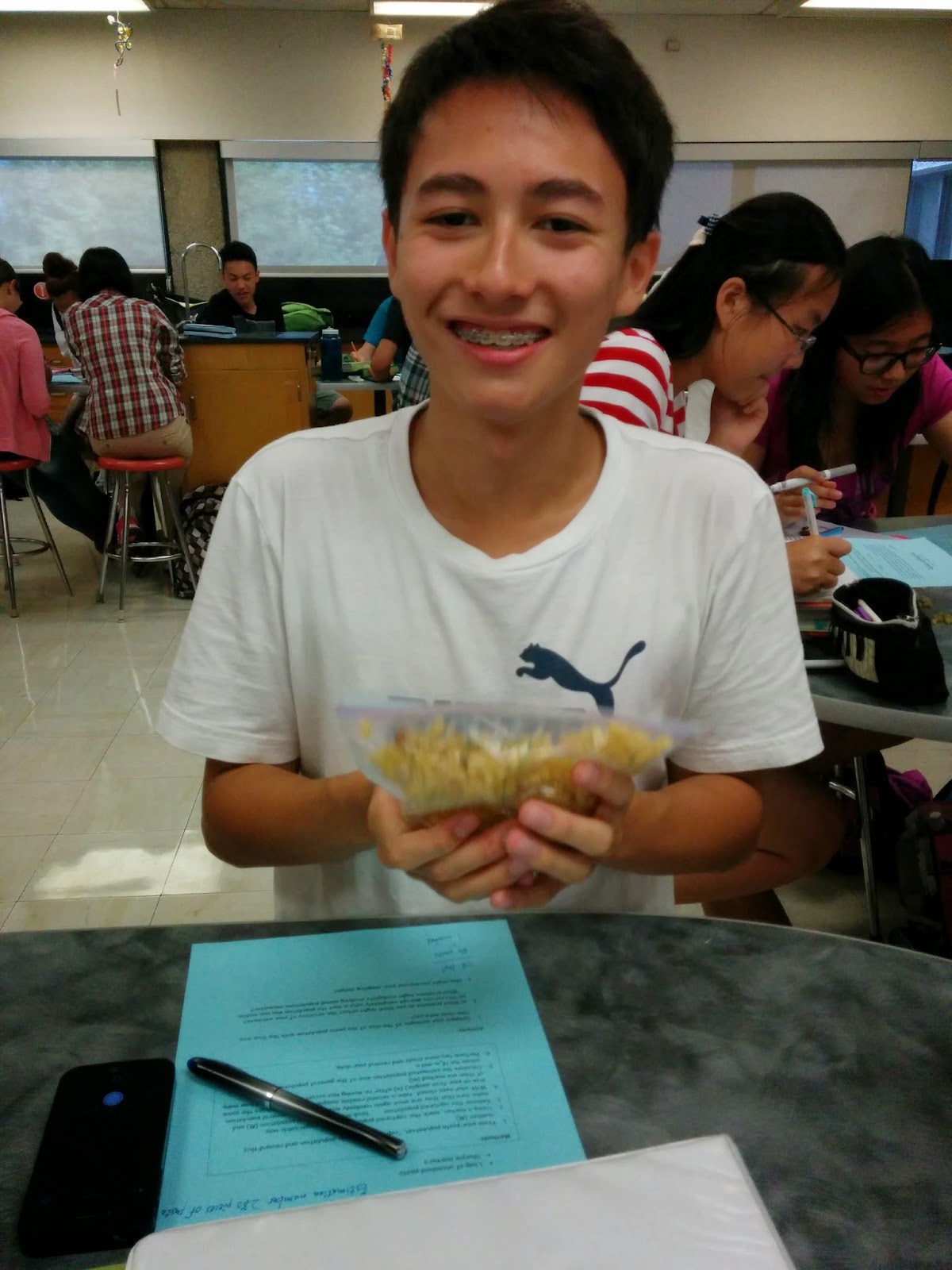
In this lab, each group was given a bag of pasta, which served as the population, and was instructed to estimate the number of pasta in the bag by using the mark - recapture method.
My group, consisting of Jordan, Katherine, and myself, began by "capturing" a sample of pasta, counting it, and marking all the individuals (we decided to use the letter 'A' as our tag).
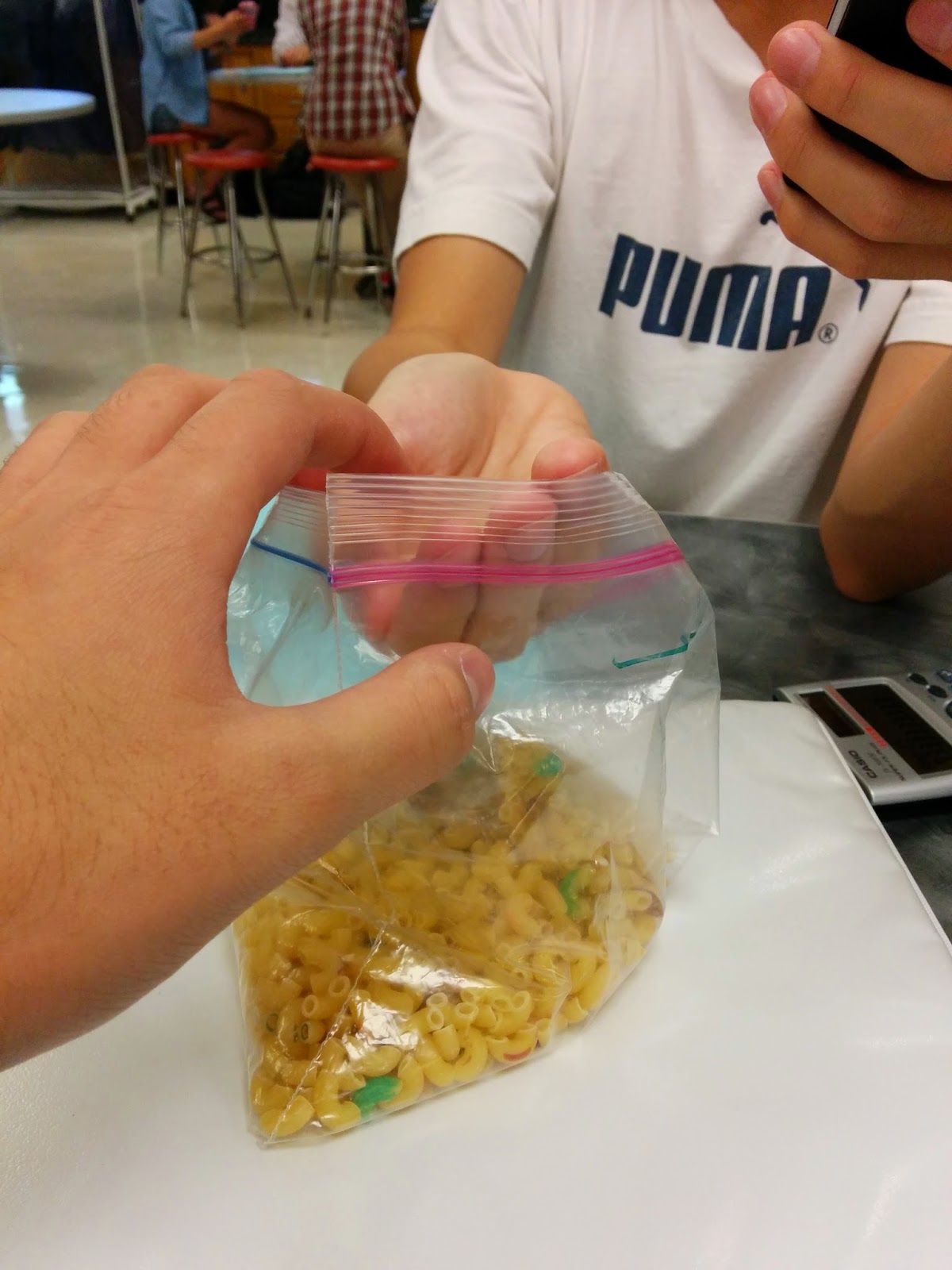
Capturing the pasta
A letter 'A' represented the marked individuals


Shaking the bag to ensure that the pasta was
evenly distributed

Once this was accomplished, the marked individuals were released and allowed to mingle with the rest of their population (we had to help them out a bit by shaking the bag).


Capturing the second sample with closed eyes
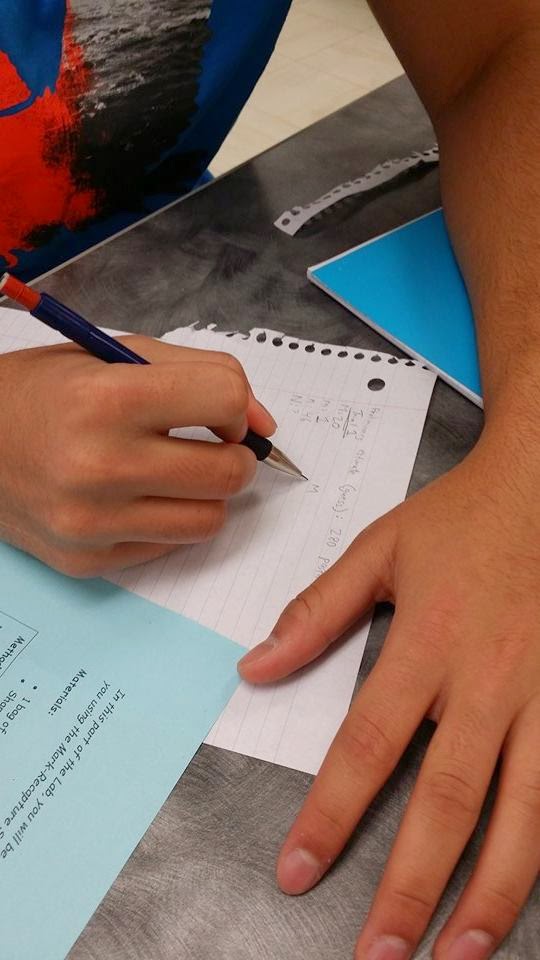
Doing the calculations
The second sample was then captured (without looking), and the number of marked individuals were counted along with the total size of the second sample. Calculations were made to estimate the total number of pasta in the bag.

We performed three trials, using a different marking each time so that we wouldn't count individuals captured in previous trials. We then averaged the results of the trials, and began the arduous task of counting all the pasta in the bag to determine how accurate we were. One of the trials, the first one, was quite obviously an outlier: The estimated population size was 920, a number which was obviously too large to be possible. The reason this occurred was most likely that out initial sample size was too low (we only captured 20 individuals in the first sample). Sure enough, our next two trials, for which we captured significantly more pasta, resulted in numbers which were closer together and more reasonable (585 and 552). Using these numbers and the real population size, which was counted to be 558, we found our percent error with the outlier and without. With the outlier, our error rate was 23% and without, it was only 2%. This shows that the mark and recapture method can be a very efficient and accurate tool for scientist to use (when carried out correctly).

There were a few factors which could affect the accuracy of the experiment. One that we observed in our own experiment was that the sample size for one of the trials (the first one) was too small, and we were only able to recapture one individual, leading to a large discrepancy between the other trials. Other groups had used the same pasta bags for their own experiments in previous years. It's possible that the marking we chose was identical to a marking used by another group that we were not aware of, meaning that we would capture more marked individuals in the second sample, throwing off the results of the experiment.

In the real world, mark and recapture isn't as easy of efficient as this lab, because we were working in a closed system-one which was controlled and less prone to unforeseen problems. When researchers are working with animals, a whole new set of problems emerge. The one which likely affects the results most is mortality; marked individuals dying or being killed by predators or even poachers, depending on the species. This source of error becomes more prominent over time. Additionally, tags which weren't applied properly may fall off, and animals with the intelligence to do so will likely try to remove the tags. In some cases, the mark might distinguish the individual from other members of its species, possibly compromising its ability to avoid predators - this would lead to the marked individuals being preyed upon more than their unmarked counterparts.

In order to improve the design of this experiment, I would make the sample sizes exact (the same number of individuals marked and recaptured for each trial). This would make the results more accurate and add more control to the experiment.